
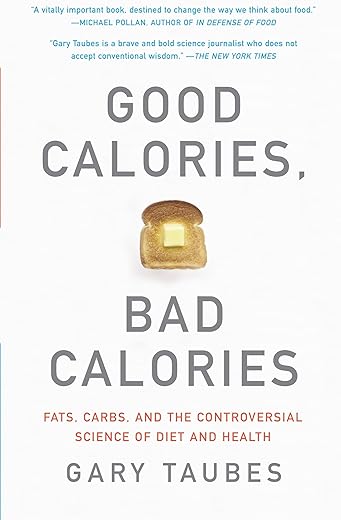
Good Calories, Bad Calories: Fats, Carbs, and the Controversial Science of Diet and Health
55
 Adams Parker

Product Images
Product Features
This groundbreaking book by award-winning science writer and bestselling author of Why We Get Fat and The Case for Keto shows us that almost everything we believe about the nature of a healthy diet is wrong.
“Gary Taubes is a brave and bold science journalist who does not accept conventional wisdom.” —The New York Times
For decades we have been taught that fat is bad for us, carbohydrates better, and that the key to a healthy weight is eating less and exercising more. Yet despite this advice, we have seen unprecedented epidemics of obesity and diabetes. Taubes argues that the problem lies in refined carbohydrates, like white flour, easily digested starches, and sugars, and that the key to good health is the kind of calories we take in, not the number.
Called “a very important book,” by Andrew Weil and ”destined to change the way we think about food,” by Michael Pollan, this groundbreaking book by award-winning science writer Gary Taubes shows us that almost everything we believe about the nature of a healthy diet is wrong.
“Gary Taubes is a brave and bold science journalist who does not accept conventional wisdom.” —The New York Times
For decades we have been taught that fat is bad for us, carbohydrates better, and that the key to a healthy weight is eating less and exercising more. Yet despite this advice, we have seen unprecedented epidemics of obesity and diabetes. Taubes argues that the problem lies in refined carbohydrates, like white flour, easily digested starches, and sugars, and that the key to good health is the kind of calories we take in, not the number.
Called “a very important book,” by Andrew Weil and ”destined to change the way we think about food,” by Michael Pollan, this groundbreaking book by award-winning science writer Gary Taubes shows us that almost everything we believe about the nature of a healthy diet is wrong.
Read more
Product Specifications
Didn't find the right price? Set price alert below
Set Alert for Product: Good Calories, Bad Calories: Fats, Carbs, and the Controversial Science of Diet and Health - $1,052.49

Product Price History
-


![[1607744627] [9781607744627] The Prediabetes Diet Plan: How to Reverse Prediabetes and Prevent Diabetes through Healthy Eating and Exercise-Paperback](https://m.media-amazon.com/images/I/711cMO7ILoL._AC_SL520_.jpg)

Amazing, whistle blowing book. This book is without a doubt the most all inclusive, exhaustively researched book on dietary issues that exists. I read it front to back and am now re-reading it with my pink marker. You have to have a real interest in the subject to wade through all the information, it’s not light reading. However, what is presented is mind blowing yet I had a sense of “I knew this all along.” What really amazed AND disgusted me was the extent of sloppy and often bad science that has existed over the years with regard to weight gain, the influence of politics and media in misleading the public, often quite deliberately, other times just due to weak intellect. Taubes discusses it all, and the evidence is pretty plain. He footnotes everything, all the studies, the conferences, he names all the names. The back of the book has 44 pages of footnoted references, followed by a 66 page bibliography. Taubes is an impressive researcher, and as he said at one point, prior to the internet and its ability to facilitate research, this particular book would have been a lifetime of work to assemble.Four years ago, suffering from a sprained shoulder and broken rib from a ski fall, and therefore unable to exercise for a time, I embarked on the Atkins diet to lose that proverbial last 20 lbs which seemingly would not budge despite fairly careful eating and a strenuous 6-day a week exercise regime. To my amazement, on the Atkins diet the weight fell off effortlessly and I felt marvelous. A few years later, I realized that I was both gluten and casein sensitive and the lack of grains, sugar, fruit and dairy in the Atkins induction diet explained why I felt so wonderful. It was obvious those omitted foods influenced whether I gained or lost weight. After reading this book, I now understand the full extent of why that weight came off so easily and quickly, how effortlessly I reached my ideal weight, and why I came to realize I hadn’t known what it felt like to food GOOD all the time.Looking back at my childhood in the 50’s and 60’s, this was a time in which not I, not my family, not anyone I knew, none of my schooolmates were at all overweight and you just didn’t see very many hugely obese people anywhere. The grossly bloated and obsese people you see so commonly today were a total rarity at that time. The cause of so much of today’s overweight is fairly obvious to pinpoint, and you have only to take a walk thru your local supermarket, pay attention to the products of the fast food restaurants (can you find anything that isn’t fried/breaded/carb loaded??), and look at the typical diet everyone today tends to eat: grains grains grains at every meal, high carbs at every meal, loads of sugar and high fructose corn syrup (in virtually everything processed), and relatively less protein, very few vegetables (no, french fries don’t count as a vegetable!), not much fat and not enough fruit. We are overloading ourselves with pure junk food from morning to night, most of it almost totally deficient in nutrients, but in other eras our typical diet was not like this.Growing up my mom cooked meat, fairly minimal amounts of starch such as potatoes/rice, lots of veggies, fruits. We rarely had sodas (occasional treat only), desserts such as cakes or pies were infrequent, we didn’t have snack foods such as chips, crackers, cookies in the house. We just didn’t munch on junk between meals and if we needed a snack it would be an apple or some nuts. Breakfast cereals were relatively few and were generally corn flakes, Wheaties, Rice Krispies, etc., but again, they were consumed in very small amounts and not so full of sugar and chemicals. Think about the cereal aisle of today’s market: dozens and dozens of cereals, a very high profit item by the way, most of them pure junk and chock full of sugar and chemicals. They are eaten for breakfast, they are snack foods. Kids stuff themselves with junky cereals. So making these observations on my own, I’ve always felt these differences in eating were marked from that era to what it is today, and I now see that idea was completely on track. While at age 58 I remember how I used to eat as a kid and teen, today’s kids have never had the contrast and they think the foods we eat today are as it has always been. And they are nutritionally illiterate.It’s hard to go against the grain of “medical wisdom”, but the fact is, as Taubes so aptly reveals, that with regard to obesity research, there has been no mainstream “medical wisdom” and the researchers who WERE on track were ignored or disregarded. Look at how maligned Atkins was! Taubes points out that scientific research was SUPPOSED to pose a hypothesis and then try to prove it false. Obesity research has been marked by posing a hypothesis and disregarding anything that was contrary, and collecting only the evidence that proved the hypothesis true. There has been a LOT of political influence…..if a scientist and his research is funded by General Mills, for example, it’s not in his interest to report that certain products are unhealthy. This sort of thing has been done to a truly remarkable extent, and the impact has been devastating to our collective health. There has not been honesty of purpose in much of obesity research.I suggest that everyone read this book….it’s a substantial and involving read, and it probably needs to be read several times to truly digest it all, but it’s fascinating all the way. It shows how we have been misled to be a nation of pill-takers for conditions that could largely be resolved by the proper DIET, and not with pills. (Think of the influence of pharmaceutical companies here: what would they do without the sales of diabetes meds, heartburn meds, cholesterol lowering meds, high blood pressure meds, the list goes on). The diseases of civilization….diabetes, heart disease, cancer and many others…..the link to your diet will crystal clear after reading this book, and the volume of evidence is undeniable. It’s obvious that the wrong foods are hugely responsible for much, if not virtually ALL of the “diseases of civilization”. It follows that the right diet could also eliminate these diseases over time. This is the amazing thing, the truth is actually quite obvious if people will get their heads out of the sand and look at it! Go into reading this book with an open mind, and you will see what you need to do. “Medical wisdom” is not the god you may have thought it was.With regard to what you eat, most people tend to believe that if a food can be bought, it must be “OK.” But that’s just not true. There’s a saying we should all remember: “Just because you CAN eat it, doesn’t mean you SHOULD.”Taubes deserves a medal, some sort of major award, national scientific and medical recognition for his massive contribution to understanding and treating obesity with this book. Sadly, if things continue as they have in the last 50+ years, the book will be dismissed, maligned, and largely ignored by the scientific community AND with the press, who could, if they were so motivated, bring this information to the attention of the reading public.
Both the big picture and the little details. A book this detailed and controversial is difficult to review without writing another book in the process. Since many reviews have already covered much of the content and conclusions, I’ll try to say things that aren’t already in the list of 156 reviews so far (that I recall). (…which is not easy.)This book is a review of science. That the science happens to be about nutrition is primary only if that is your actual interest. People interested in the nature of science and its process, politics and pitfalls, should find this fascinating even if they never gave a thought to why fat seems so much easier to gain than to lose (particularly in the larger amounts), or to why the “diseases of civilization” (diabetes, heart disease, Alzheimer, schizophrenia, cancer, etc.) are skyrocketing.There are several critically important topics in nutrition and related areas that could have been added to this, but I suspect a 2000 page book would have been difficult to sell. It’s obvious he had to choose a focus and a linear path through a gigantic topic.As part of the fact that it is a science review and not a novel or diet book, there are a few important considerations.1. It is a review of science; it is not science itself except in the form of intelligent inquiry and review; it is not “research”. Taubes is not a formal researcher, though he is science-trained and specializes in investigating and writing about science. In short, this is OLD research, not NEW research: it’s just that it’s research many people probably either don’t know about or learned about rather differently.2. Aside from a small ‘final conclusions’ bit, there isn’t really anything to argue about in terms of ‘disagreeing with Taubes’ in this; rather, people would have to argue with the actual research reviewed. Readers could complain about what is included or excluded (‘too much’ some say, ‘not enough’ say others), that’s about it. Even if one disagrees with Taubes’s overview-conclusions, the degree of careful detail combined with the linear-layout and the courage to present a truly alternative view on highly politicized issues (some of his ideas left me stunned, they were so new to me!), is worthy of respect.3. This book is just slightly like a nutritional version of ‘Forbidden Science’ (about Archeology), and I translate the point of it rather like this: “For those formally educated, here’s the stuff you probably didn’t learn, or didn’t learn in this way for sure, and of what you did learn, here’s a new look at some of the assumed cornerstones of belief-system edifices. And for those not formally educated, here’s a trail through history and science to start with: here’s what’s accepted then and now, and here’s an alternative path to consider.” What readers want to do with all that is entirely up to them. The most important thing is getting the information into the larger world to be at least considered and brought to light finally or differently in some cases; what part of all this turns out to be right, or wrong, or misunderstood, or differently understood, in the end is less the issue here than just finally beginning some kind of dialogue on these important points.4. I doubt the Final Answer[tm] of nutrition is yet at hand, and so I’m sure there must be plenty of areas to further explore and in the end, it might not all agree with the general framework Taubes ended up with (or, it might–I don’t know). It’s a review of so many different studies and related areas, that it is highly unlikely any single work could be perfect or perfectly complete on all that — it would have to be 10x its length, at least, and be written from a century in the future. The important thing is that the book became available at all, because it is the first thing courageous enough to “question authority” to this degree, detailed enough to provide a jumping-off point for legitimate medical people to re-evaluate some old ideas on their own, and yet readable enough to provide an entry gateway to at least a small portion of the layman public.5. This is an educational book, but it is not entry-level except for very good readers with some understanding of basic science. This is no dumbed-down textbook; this actually requires some decent cognitive skills. I found it fascinating, but although I can read about 800 pages in a day if I have all the daylight hours, it took me a full week to wade through it in long evenings after work. (This might have gone faster, did I not have to keep stopping to rant and rave to a friend about things in the content!) If you are not a strong reader, I do not recommend it unless you have a year to work on it.6. The book is very dense in information, and this is its strong point and its purpose. That means if you’re not into the topics of science or nutrition etc., it’s either going to put you to sleep or fry your brain. I loved it: the world has more than enough simple diet books for laymen. What we really needed was a book that combined science detail with readability, and science history with the commercial present, for an understanding of how we got to where we are, and what that means to science, to nutrition, to health, and to our future, both as individuals and as a species.7. On the problem side, the publisher’s presentation makes this seem like a “diet book”. This is not a paint-by-number eating plan. If you want a book about what to eat and when and how to count it, there are many, but this isn’t one of those. It’s also not a “pleasant afternoon reading,” unless you’re a fairly serious intellectual. That is sure to disappoint many who are unlikely to be willing to get through it. (Some people are simply better with other forms of learning than dense text, and this really IS “dense text”.) It is a good thing this book is not exactly for the masses, though, since I think if we could take all this information and distill it into sound-bytes that the public would easily understand, there might be lynch mobs arriving at some health agency doorways.**I feel that nobody in the field of medicine could write this book: they’d be ruined for the degree of questioning the party line/ status quo, and if they were researchers they wouldn’t get funding from any of the all-pervasive sources (generally, the food industries killing us and the pharmaceutical industries not-curing but eternally-treating us), and the problem is, a person educated in that system is highly unlikely to break out of the mold to find this road to begin with, unless they are really exceptionally independent thinkers. Gary’s position as a science writer, and the years he put into studying this, combined with him having no major vested interests in the conclusions (such as some of the more consumer-book authors of lowcarb diet plans), is the perfect combination. It’s too ‘heavy’ to ever make him much money I bet (too small an audience), nowhere near worth the hours and years he put into it, but I hope that he doesn’t regret the work, because I’m sure many people are genuinely grateful for the book — I am.**I’m from a family of huge women. Women who basically diet constantly for 20, 30, 40 years and they’re still fat. I was fairly athletic until my mid-20s, when two years of a very intense, work+school+commute, sleep deprived, high stress, not eating daily except mega-carbs right before sleep, resulted in a massive rapid weight gain. Later when traditional dieting didn’t work at all for me, I simply gave up, not willing to be neurotic daily about something my family made seem unsolvable. (OK, I nearly shot myself over it in all honesty, but once I got over myself, I moved on.)About 15 years later (now huge), I was hospitalized for untreated asthma infections. While there I had a heart-rate reaction to days of steroids plus pain and a situation, and that got me assigned a cardiologist (though I had no heart condition). When I got out of the hospital and visited him, he wrote me a prescription to the Protein Power Life Plan book by the Drs. Eades.Helluva drug: I’ve kept off over 125lbs for 18 months now, and medical symptoms (acid reflux, complexion problems, severe asthma, allergies, unexplained rashes, chronic exhaustion, brain-fog, bloating, etc.) all vanished within weeks of making an effort to ditch most carbs and increase protein and fat and add some supplements (no exercise involved).In fairness, this can’t all be attributed to lowcarb, because getting off gluten (solely by accident to begin) is a good chunk of the symptom resolution. I am exercising more now that I can finally move enough to do some of it. (I can mow my lawn, weed it, rake it, shovel soil for the garden. As of September 18 2006 when I went on lowcarb, I couldn’t even stand for 60 seconds without screaming back pain, couldn’t walk around a store. The changes in my life are radical.)But my respect for Taubes’s book is not because of my experience; rather, it’s because he finally gave me a way to help my brain’s intellectual understanding connect with my body’s experiential reality. I really needed to understand some of this which seemed very confusing as it contradicted all the tenets of “pop science”. I am no expert on anything, and I was cynical about “lowcarb” at first, but the results have been good enough to change my life, and my future, and make me seriously interested in the subject. I may never be thin, but at least I’ve learned enough to head off destruction.Reading about why poor science, social good-ol-boys and political peer pressure has resulted in the train wreck of modern nutrition/healthcare, realizing that nearly 20 years of my life were basically trashed as a result of believing the government’s advice, made me a little homicidal for awhile, but I recovered. Now, I’d just like to see some decent, intelligent dialogue and research happening thanks to this guy’s gutsy exploration and road map to another view. I’m guessing not too much will happen and he’ll have to get old and die before the larger world recognizes just how important this book is (was) at this time.If you are interested in these subjects and you read very well, this book is the boss. No matter what you believe or don’t about nutrition, this book is worth a read.
Gary Taubes schafft es mit diesem bahnbrechenden Werk die Zusammenhänge der letzten 200 Jahre Wissenschaftsgeschichte in Medizin, Ernährungs”wissenschaft” und anderen nach zu zeichnen und so ein klares, unglaublich mutiges und differenziertes Bild der Entstehung, Ursachen, Hintergründe und Lösung vieler, ernährungsbedingter Volksleiden wie Adipositas, Übergewicht, Diabetes II, etc. dem Leser zu vermitteln. Der klaren, sehr spannenden Aufbereitung der wissenschaftlichen Fakten und menschlichen Schwächen zahlreicher (überbewerteter und fälschlich als vertrauenswürdig bewerteten) Wissenschaftlicher und v.a. auch Pseudo-Wissenschaftler, ebenso wie Politiker gebührt Dank und Hochachtung.Es wird verständlich, warum über Jahrzehnte Falschinformationen und Meinungen einzelner den Bevölkerung, gerade in USA und Deutschland als “Ernährungsempfehlungen” verkauft wurden (wenig Fett, viele Kohlenhydrate z.B.), welche dazu führten (und immer weiter dazu führen), dass Übergewicht, Adipositas, Diabetes, jedes Jahr weiter zunehmen und nicht nur die Mehrheit unserer sog. reichen Industriestaaten davon betroffen ist, sondern bald unglaubliche 70 oder gar 80% nach div. Schätzungen. Zeit aufzuwachen aus dem Informationsnetz an Falsch- und Fehlinformationen, schlechter und Pseudowissenschaft, das überwiegend Meinungs-basiert ist und dem überwiegend keinerlei ernst zu nehmende Wissenschaft zu Grunde liegt.Es ist durchaus als bahnbrechend zu bezeichnen, im Laufe der 650 Seiten fallen einem viele Zusammenhänge wie Schuppen von den Augen. Vieles klärt sich. Zum Beispiel, dass Reduktionsdiäten nur eine 1%-ige Erfolgschance haben und gleichzeitig als das Non-Plus-Ultra von allen Fachgesellschaften zur Gewichtsabnahme empfohlen werden. Wobei von vielen Stellen deren mangelnde Wirksamkeit inzwischen teilweise wenigstens erwähnt wird. Was diese jedoch nicht daran hindert sich gleichzeitig zu widersprechen und, wie die Deutsche Gesellschaft für Ernährung oder die Deutsche Diabetes Gesellschaft (ebenso wie deren amerikanische Pendants), weiterhin diese als einzig wirksame Methoden empfehlen. Ebenso, dass – und das ist zentral – die wichtigsten Ursachen der Übergewichts- und Adipositas-Epidemie ein (wie auch immer gearteter) “Bewegungsmangel” und eine “erhöhte Nahrungsaufnahme” seien (v.a die angeblich so schädlichen Nahrungsfette). Die Verwechslung von Ursache und Wirkung an dieser Stelle ist einschneidend. Die dargelegten (wissenschaftlich unstrittigen) Zusammenhänge von Kohlenhydrat-reicher Nahrung > dauerhaft erhöhtem Insulinspiegel > Aufbau von Körperfett und Verhinderung des Verbrauchs von Körperfett, ist einleuchtend. Und dennoch weitgehend ignoriert in der Fachwelt. Und in den Bevölkerungen oft unbekannt.Das Buch beschreibt auch ein- und nachdrücklich, welche unglaublichen Vorgänge im Bereich der Forschung im Bereich Medizin (v.a. chronische Krankheiten und Adipositas, bzw. Übergewicht) und Ernährung die letzten Jahrzehnte beherrschten: schlechte oder völlig vernachlässigte Wissenschaft, Aufstellen von unbewiesenen Behauptungen und jahrzehntelanger Ignoranz und stetiges Verkaufen von persönlichen Meinungen als wissenschaftliche Ergebnisse. So konnte z.B. bis heute der Zusammenhang von Nahrungsfetten und Krankheiten wissenschaftlich nicht bewiesen werden (was auch von Fach-Autoritäten gerne anders dargestellt wird, aus welchen Gründen auch immer). Ebenso wenig, und das ist wohl der größte Verdienst von Gary Taubes, wurde seine Kohlenhydrat-Hypothese bisher ausreichend wissenschaftlich erforscht und wird glasklar verständlich, warum – z.B. aus Ignoranz und schlechter Wissenschaft vermutlich – was sich nach diesem Buch jedoch ändern dürfte. Nachdem die in Medizin, Ernährungswissenschaft und Gesundheitspolitik vorherrschenden Meinungen eben genau das sind – Meinungen, und nichts davon einer wissenschaftlichen Überprüfung stand hält, kann die Wahrscheinlichkeit, dass Gary Taubes Kohlenhydrat-Hypothesen richtig sind, als sehr hoch angesehen werden.Dieses aufrüttelnde Werk sollte jeder Mediziner, Ernährungswissenschaftler, Gesundheitspolitiker, Forscher in den betreffenden Disziplinen und alle direkt von Übergewicht, Adipositas, Diabetes, und allen Volkskrankheiten betroffenen Menschen lesen und sein Wissen sollte in Grundschulen unterrichtet werden. Es schafft einmalige Klarheit. Das Wissen über die wissenschaftliche Faktenlage zu Kohlenhydraten und die schädlichen Auswirkungen auf den Stoffwechsel der allermeisten Menschen und die genannten, bekannten Volkskrankheiten, könnte vielen Millionen Menschen helfen, endlich gesund zu werden oder gesund zu bleiben.Eines der mit Abstand bedeutendsten Bücher überhaupt.
Questa è la seconda copia che compro di questo libro. L’ho regalata ad un amico con cui spesso si parla di alimentazione.È un testo illuminante sui pericoli dell’eccesso di carboidrati che caratterizza l’alimentazione moderna. In più, è argomentato in maniera solidissima, con riferimenti così vari e dettagliati alla ricerca scientifica e alla storia della scienza dell’alimentazione da far comprendere come si è arrivati agli attuali modelli alimentari, alle loro criticità e le possibili alternative.Il tutto scritto in maniera rigorosissima ma accessibile. Un esempio di giornalismo di divulgazione scientifica confortante in un panorama editoriale dove toppo spesso l’argomento è vittima dell’improvvisazione e della polemica.
Great read for those interested in understanding how main stream diet advice had gotten it so wrong